
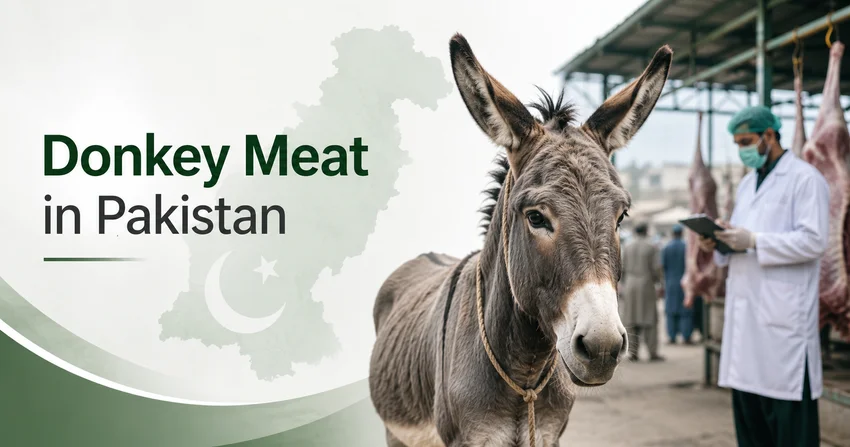
Pakistan’s decision to allow regulated donkey meat exports has created widespread discussion. However, many people confuse legal exports with the illegal sale of donkey meat in local markets.
Pakistan allows approved companies to process and export donkey meat and hides through regulated facilities, particularly in the Gwadar Free Zone. In contrast, sellers cannot secretly offer donkey meat as beef or mutton. Such practices can violate food-safety, labelling and consumer-protection laws.
Moreover, domestic donkey meat carries religious concerns for Muslim consumers. Islamic scholars generally classify the meat of domesticated donkeys as haram.
Quick Answer
Pakistan permits the regulated export of donkey meat and hides under specific sanitary and trade protocols. However, this approval does not allow businesses to sell donkey meat secretly in local markets or mislabel it as beef or mutton.
Authorities treat undisclosed meat substitution as food fraud. In addition, Muslim consumers avoid domestic donkey meat because mainstream Islamic teachings prohibit it.
Why Are People Discussing Donkey Meat in Pakistan?
The issue gained national attention after food authorities discovered donkey meat during a raid in Tarnol, Islamabad, in July 2025.
Officials recovered around 1,000 kilograms of meat and found more than 50 live donkeys at the facility. Consequently, the case raised serious concerns about illegal slaughtering, food hygiene and meat traceability.
However, one enforcement case does not prove that restaurants and butchers across Pakistan regularly sell donkey meat. Consumers should therefore avoid believing every viral social media claim without laboratory evidence or an official investigation.
At the same time, Pakistan has also developed a regulated export route for donkey products. As a result, people often mix two separate matters:
- Legal export through approved facilities
- Illegal sale or mislabelling in the domestic market
Understanding this difference helps consumers avoid confusion.
Is Donkey Meat Legal in Pakistan?
The answer depends on how and where businesses process and sell it.
Regulated Export
Pakistan has approved the export of donkey meat, hides and related products through designated facilities in the Gwadar North Free Zone.
Approved businesses must follow sanitary rules, veterinary requirements, traceability procedures and the importing country’s regulations. Furthermore, government agencies can inspect the animals, processing facilities and export documents.
Therefore, a company may legally export donkey products when it follows every applicable rule.
Local Sale and Mislabelled Meat
The export approval does not allow shops, restaurants or suppliers to sell donkey meat as beef or mutton.
For example, a butcher cannot secretly replace beef with donkey meat and charge customers for beef. Similarly, a restaurant cannot use an undisclosed animal species in kebabs, mince or other dishes.
Such actions may involve:
- Food fraud
- False labelling
- Unsafe slaughtering
- Unlicensed food processing
- Consumer deception
- Religious rights violations
Therefore, consumers should separate legal exports from illegal domestic substitution.
Does Pakistan Export Donkey Meat to China?
Yes, Pakistan has created a regulated framework for exporting donkey meat and hides to China.
China has a commercial market for several donkey-derived products. For instance, some industries use donkey hides to produce ejiao, a traditional gelatin-based product. In addition, certain regions consume donkey meat as food.
Pakistan views this trade as a possible source of:
- Export revenue
- Foreign investment
- Livestock-sector growth
- Employment opportunities
- New commercial farming projects
However, the government must maintain strict oversight. Otherwise, unregulated traders could divert animals or meat into informal domestic markets.
Therefore, Pakistan needs a clear separation between the export supply chain and the local beef and mutton market.
Why Does China Import Donkey Products?
China imports donkey products for food, traditional products and industrial processing.
First, manufacturers use donkey hides in the production of ejiao. Second, some consumers eat donkey meat in regions where local food traditions include it. Third, businesses may use other by-products for commercial purposes.
Consequently, demand for donkey products has increased interest in donkey breeding and processing projects in several countries.
Nevertheless, Pakistan must protect its existing working-donkey population. Many low-income families still rely on donkeys for transport, agriculture and labour. Therefore, commercial breeding projects should produce animals specifically for the export industry instead of removing working animals from local communities.
How Many Donkeys Are There in Pakistan?
The Pakistan Economic Survey 2025–26 estimates the country’s donkey population at approximately 6.2 million.
Earlier estimates showed:
- 5.9 million in 2023–24
- 6 million in 2024–25
- 6.2 million in 2025–26
However, these figures represent official estimates rather than an exact physical count of every animal.
Even so, Pakistan has one of the world’s largest donkey populations. Therefore, policymakers see potential commercial value in regulated breeding and export programmes.
Is Donkey Meat Halal or Haram?
Mainstream Islamic scholars classify the meat of domesticated donkeys as haram.
Islamic teachings distinguish domesticated donkeys from wild asses. According to authentic hadith reports, the Prophet Muhammad ﷺ prohibited Muslims from eating domesticated donkey meat during the Battle of Khaybar.
Therefore, Pakistani Muslim consumers have a religious right to know the exact species of meat they purchase.
When a seller secretly replaces beef or mutton with donkey meat, the seller does more than commit food fraud. The seller also prevents Muslim consumers from making an informed halal choice.
For this reason, accurate meat labelling plays an essential role in Pakistan’s food system.
Is Donkey Meat Dangerous to Human Health?
Donkey meat does not automatically become poisonous simply because it comes from a donkey.
However, unregulated meat can create major health risks. Illegal operators often slaughter animals without veterinary checks, clean equipment or proper cold storage.
As a result, the meat may contain harmful bacteria, parasites, chemicals or other contaminants.
Unregulated meat may also come from:
- Sick animals
- Injured animals
- Animals treated with unsuitable medicines
- Animals with an unknown history
- Unhygienic slaughterhouses
- Contaminated storage areas
Furthermore, illegal suppliers may transport meat without refrigeration. This practice allows bacteria to multiply quickly, especially during Pakistan’s hot weather.
Therefore, the main public-health risk comes from unsafe sourcing, poor hygiene and weak traceability.
Can Consumers Identify Donkey Meat by Colour or Smell?
Consumers cannot reliably identify donkey meat through colour, texture, smell or taste alone.
Several factors can change the appearance of meat. For example, the animal’s age, diet, health, body part and storage method can affect its colour and texture.
Moreover, spices and cooking methods can hide natural differences. Mince, kebabs, sausages and heavily seasoned dishes make visual identification even more difficult.
Social media posts often claim that donkey meat has a specific smell, colour or cooking behaviour. However, these methods do not provide dependable proof.
Instead, laboratories use DNA or PCR testing to identify the animal species accurately.
Therefore, consumers should report suspicious meat to the authorities rather than relying on homemade identification methods.
How Can Consumers Protect Themselves?
Consumers can reduce their risk by buying meat from reliable and registered sellers.
Choose Licensed Meat Shops
First, purchase meat from recognised butcher shops, supermarkets or suppliers. Licensed businesses usually follow stronger inspection and record-keeping requirements.
Check the Shop’s Hygiene
Next, examine the condition of the shop. Clean counters, covered meat, proper refrigeration and hygienic tools indicate better food-handling practices.
However, cleanliness alone does not guarantee authenticity. Consumers should also consider the seller’s reputation and registration status.
Ask for a Receipt
A receipt creates a record of the purchase. Therefore, it can help authorities identify the seller during an investigation.
For institutional or bulk purchases, buyers should also request supplier details, invoices and inspection documents.
Check Packaged Meat Labels
Packaged meat should clearly mention:
- Animal species
- Processor’s name
- Packing date
- Expiry date
- Storage instructions
- Batch or traceability information
If the label looks incomplete or altered, consumers should avoid the product.
Be Careful With Extremely Low Prices
An unusually low price does not prove that a seller uses donkey meat. Nevertheless, it can indicate low-quality sourcing or unsafe handling.
Therefore, consumers should remain cautious when a price appears far below the normal market rate.
Avoid Spreading Unverified Claims
Consumers should not publicly accuse a butcher or restaurant without evidence.
Instead, they should document the concern and report it to the relevant food authority. This approach protects both consumers and legitimate businesses.
How Can People Report Suspicious Meat?
Consumers should contact the food authority operating in their province or territory.
In Punjab, consumers can contact the Punjab Food Authority through its helpline. Meanwhile, residents of Islamabad can report concerns to the Islamabad Food Authority or the local administration.
Similarly, consumers in Sindh, Khyber Pakhtunkhwa, Balochistan, Gilgit-Baltistan and Azad Jammu and Kashmir should contact their relevant provincial or regional authorities.
When reporting suspicious meat, consumers should provide:
- Seller’s name
- Shop or restaurant location
- Date and time of purchase
- Receipt
- Product packaging
- Photographs or videos
- A description of the concern
In addition, consumers should preserve the product safely when authorities request a sample. However, they should not eat meat that appears spoiled or suspicious.
What Should the Government Do?
Pakistan can develop a legitimate donkey-product export industry, but strong regulation must guide every stage.
Introduce Animal Traceability
Authorities should register animals that enter the export supply chain. As a result, inspectors could trace each animal back to its farm or breeding facility.
Use Dedicated Export Facilities
The government should limit donkey slaughtering and processing to approved export zones. This step would reduce the risk of mixing donkey products with local beef and mutton supplies.
Strengthen Veterinary Inspection
Veterinary teams should examine animals before and after slaughter. In addition, they should check for disease, medicine residues and poor animal health.
Conduct DNA Testing
Food authorities should regularly test meat samples from markets, restaurants and processing facilities.
In particular, authorities should focus on mince, kebabs, sausages and other products where suppliers can easily hide the original species.
Enforce Clear Labelling
Exporters must identify the animal species clearly on containers, records and shipping documents.
Similarly, domestic meat sellers should provide accurate information about every product they offer.
Protect Animal Welfare
Commercial operators should follow humane standards for breeding, housing, transport and slaughter.
Furthermore, authorities should prevent businesses from purchasing weak or overworked animals from poor families at unfair prices.
Publish Inspection Results
Government agencies should share licensing, inspection and enforcement information with the public.
Consequently, transparent reporting would reduce rumours and improve consumer confidence.
Common Myths About Donkey Meat in Pakistan
Myth: Pakistan Now Allows Donkey Meat in Every Market
Fact: Pakistan has approved regulated exports through designated facilities. However, this approval does not allow sellers to offer undisclosed donkey meat in ordinary local markets.
Myth: Every Cheap Kebab Contains Donkey Meat
Fact: A low price does not prove meat substitution. Authorities need laboratory testing and supply-chain evidence to confirm the animal species.
Myth: Donkey Meat Is Always Poisonous
Fact: Donkey meat does not automatically contain poison. Nevertheless, meat from an illegal and unhygienic facility can pose serious health risks.
Myth: One Raid Proves a Nationwide Problem
Fact: The Islamabad raid exposed a serious case. However, it does not prove that every city or restaurant faces the same issue.
Myth: People Can Identify Donkey Meat While Cooking
Fact: Spices, processing and cooking methods can hide differences. Therefore, DNA testing offers a more reliable answer.
Frequently Asked Questions
Is donkey meat legal in Pakistan?
Pakistan permits regulated donkey meat exports through approved facilities. However, businesses cannot secretly sell it as beef or mutton in the domestic market.
Does Pakistan export donkey meat to China?
Yes. Pakistan has approved a controlled export framework for donkey meat, hides and related products, particularly through the Gwadar Free Zone.
Is donkey meat halal?
Islamic scholars generally classify domestic donkey meat as haram. Therefore, Muslim consumers must receive accurate information about the meat they purchase.
How many donkeys are there in Pakistan?
The Pakistan Economic Survey 2025–26 estimates Pakistan’s donkey population at around 6.2 million.
Can you identify donkey meat by its smell?
No reliable smell test can confirm the animal species. Instead, laboratories use DNA or PCR testing for accurate identification.
Is donkey meat poisonous?
Donkey meat does not automatically contain poison. However, meat from sick animals or unhygienic facilities can cause serious health problems.
What should I do if I suspect fake meat?
Do not consume the product. Keep the receipt and packaging, document the seller’s details and report the matter to the relevant food authority.
Conclusion
Pakistan’s donkey meat debate involves two separate issues.
First, Pakistan has allowed regulated businesses to export donkey meat, hides and related products through approved facilities. This trade can support investment and export revenue when companies follow strict sanitary, veterinary and traceability rules.
Second, the illegal sale of donkey meat as beef or mutton remains a serious concern. It can deceive consumers, violate food-safety laws and interfere with the religious choices of Muslims.
Therefore, authorities must keep the export supply chain separate from the domestic meat market. They should also conduct regular inspections, DNA testing and transparent enforcement.
At the same time, consumers should buy meat from trusted sellers, keep receipts and report suspicious products through official channels. Together, stronger regulation and informed consumer behaviour can improve food safety and reduce misinformation in Pakistan.