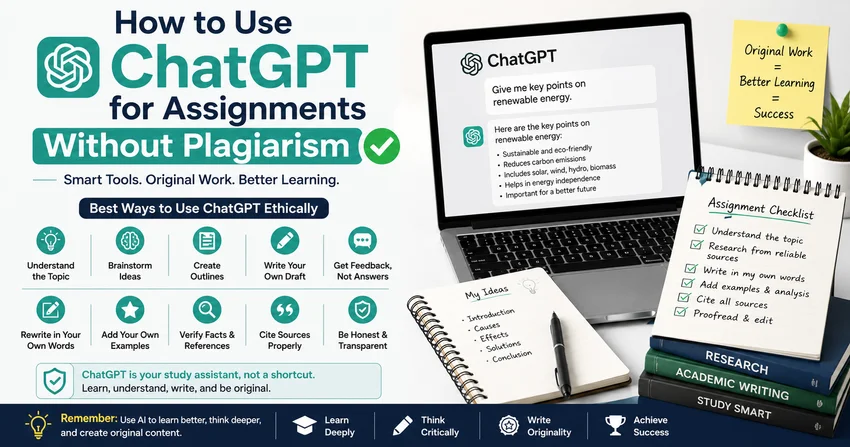
Artificial intelligence has changed the way students learn, research, write, and complete academic tasks. ChatGPT is now widely used by students for brainstorming ideas, understanding difficult topics, improving writing, and organizing assignments. However, one major concern remains: how can students use ChatGPT for assignments without plagiarism?
The simple answer is this: ChatGPT should be used as a learning assistant, not as a shortcut to submit ready-made work. When used responsibly, ChatGPT can help students understand topics better, improve their writing, and build stronger arguments. But if students copy AI-generated content directly and submit it as their own, it can become plagiarism or academic misconduct.
OpenAI’s student writing guidance clearly explains that ChatGPT can help students think through ideas, understand complex concepts, and get feedback on drafts, but using it to generate an essay instead of writing it yourself is counterproductive to learning.
What Does Plagiarism Mean in Assignments?
Plagiarism means presenting someone else’s words, ideas, structure, or work as your own without proper credit. In academic writing, this can include copying text from websites, books, research papers, classmates, or even AI tools without acknowledging the source.
When it comes to ChatGPT, plagiarism can happen when a student copies an AI-generated answer and submits it without editing, understanding, fact-checking, or adding original thinking. Even if the words are newly generated, the problem is that the student did not produce the work independently.
That is why students should treat ChatGPT as a support tool, not as the final author of their assignment.
Can You Use ChatGPT for Assignments?
Yes, students can use ChatGPT for assignments, but the way they use it matters. Many schools, colleges, and universities are still updating their policies around AI use. OpenAI notes that different institutions have created different policies for AI-generated content and academic honesty, so students should always check their school’s rules before using ChatGPT in academic work.
In most cases, ethical use of ChatGPT includes using it for:
- Understanding difficult topics
- Brainstorming ideas
- Creating outlines
- Improving grammar and clarity
- Getting feedback on your own draft
- Finding research directions
- Practicing questions
- Formatting citations
Unethical use includes copying a full essay, assignment, report, or answer from ChatGPT and submitting it as your own work.
Best Ways to Use ChatGPT Without Plagiarism
1. Use ChatGPT to Understand the Topic
Before writing an assignment, many students struggle to understand what the topic actually means. ChatGPT can help explain the topic in simple words.
For example, instead of asking:
“Write my assignment on climate change.”
Ask:
“Explain climate change in simple words and give me the main causes, effects, and possible solutions.”
This approach helps you learn the topic instead of copying the answer. Once you understand the concept, you can write the assignment in your own words.
2. Use ChatGPT for Brainstorming Ideas
One of the best ethical uses of ChatGPT is brainstorming. It can help you generate topic ideas, essay angles, research questions, and discussion points.
For example:
“Give me five possible angles for an assignment on the impact of social media on teenagers.”
ChatGPT may suggest ideas such as mental health, education, communication, cyberbullying, and personal identity. You can then choose the best angle and develop your own argument.
Brainstorming is not plagiarism because you are only using AI to explore possibilities, not to submit copied content.
3. Create an Outline Before Writing
A good assignment needs proper structure. ChatGPT can help you create an outline with headings and subheadings.
For example:
“Create an outline for a 1200-word assignment on the importance of renewable energy.”
The outline can guide your writing, but the final explanation, examples, research, and arguments should come from your own understanding.
A strong outline usually includes:
Introduction
Background information
Main arguments
Examples or case studies
Counterarguments
Conclusion
References
Using ChatGPT for structure is acceptable in many cases because it helps organize your ideas, but the actual assignment should still be written by you.
4. Write the First Draft Yourself
To avoid plagiarism, always write your first draft yourself. Even if it is not perfect, your original draft shows your own thinking.
After writing the draft, you can ask ChatGPT to review it.
For example:
“Review this paragraph and suggest how I can make it clearer without changing my meaning.”
This is a much better approach than asking ChatGPT to write the entire assignment. It keeps your work original while still helping you improve quality.
5. Ask ChatGPT for Feedback, Not Final Answers
ChatGPT is useful for feedback. You can paste your own paragraph and ask for suggestions on clarity, grammar, flow, or argument strength.
Good prompts include:
“Is my argument clear in this paragraph?”
“Can you suggest improvements to the structure of my essay?”
“Which part of this answer needs more explanation?”
“Does my introduction match the topic?”
“Give feedback on my conclusion.”
OpenAI’s writing guide recommends using ChatGPT to improve structure, test logic, develop ideas through dialogue, and get feedback on drafts.
6. Rewrite in Your Own Words
If ChatGPT explains something to you, do not copy it directly. Read the explanation, understand the idea, and then rewrite it in your own words.
A simple method is:
Read the AI response
Close the response
Write what you understood
Add your own examples
Compare with your class notes
Edit for clarity
This process helps you avoid plagiarism and improves your learning.
7. Add Your Own Examples and Opinions
Assignments become stronger when they include your own analysis, examples, and viewpoint. ChatGPT can provide general information, but your teacher wants to see your understanding.
For example, if your assignment is about online learning, you can add:
Your own classroom experience
Local examples from Pakistan
A comparison between online and physical classes
Your opinion on benefits and challenges
Real-life observations
Original examples make your work more authentic and reduce the risk of sounding like copied AI content.
8. Verify Facts, Quotes, and References
ChatGPT can make mistakes. It may give incorrect facts, outdated information, or even fake references. OpenAI’s Help Center explains that ChatGPT may produce incorrect or misleading outputs, including fabricated quotes, studies, citations, or references. That is why important information should always be verified from reliable sources.
Before submitting an assignment, check:
Dates
Statistics
Author names
Book titles
Journal references
Quotes
Case studies
Legal or scientific claims
For academic work, always verify information through textbooks, official websites, journal articles, Google Scholar, or your teacher’s recommended sources.
9. Use ChatGPT to Format Citations
ChatGPT can help format citations in APA, MLA, Harvard, or Chicago style. However, you should only give it real sources that you have already checked.
For example:
“Format this source in APA 7th edition: [paste real source details].”
OpenAI’s student writing guide says ChatGPT can help with citation formatting, but students should cross-check source details against original materials for accuracy.
This means ChatGPT can help with formatting, but it should not be trusted blindly to invent sources.
10. Be Transparent About AI Use
If your school or university allows AI tools, be honest about how you used ChatGPT. Some teachers may ask students to mention AI assistance in a note or bibliography.
You can write a simple disclosure like:
“ChatGPT was used to brainstorm ideas and improve grammar. The final content, research, analysis, and examples were written and verified by the student.”
Transparency protects you from academic integrity issues and shows that you used AI responsibly. OpenAI also suggests that students can cite or share their ChatGPT conversations when AI contributes to their thinking, depending on the teacher’s requirements.
What You Should Not Do With ChatGPT
To avoid plagiarism and academic misconduct, do not use ChatGPT to:
Write your full assignment and submit it unchanged
Create fake references
Generate quotes from books you have not read
Complete exams or quizzes dishonestly
Copy AI text without understanding it
Hide AI use if your institution requires disclosure
Use AI to avoid learning the topic
ChatGPT should support your education, not replace your effort.
Best ChatGPT Prompts for Assignments Without Plagiarism
Here are some safe and useful prompts students can use:
“Explain this topic in simple words so I can understand it.”
“Give me an outline for this assignment, but do not write the full answer.”
“Suggest research questions for this topic.”
“Give me key points I should study before writing.”
“Review my draft and suggest improvements.”
“Check if my argument is logical.”
“Suggest counterarguments for my thesis.”
“Help me improve grammar while keeping my original meaning.”
“Format these real references in APA style.”
“Create a checklist to review my assignment before submission.”
These prompts help you learn and improve without copying.
How Teachers Can Identify Responsible AI Use
Responsible AI use is usually visible when a student:
Understands the topic
Uses personal examples
Cites real sources
Shows original analysis
Can explain their argument verbally
Keeps drafts or notes
Uses AI for support, not replacement
OpenAI notes that some educators ask students to log or share their ChatGPT conversations to show their thinking process and create accountability.
This shows that the future of education may not be about banning AI completely, but about teaching students how to use it honestly and intelligently.
Final Checklist Before Submitting Your Assignment
Before submitting your assignment, ask yourself:
Did I write the final answer in my own words?
Did I understand every point I included?
Did I add my own examples or analysis?
Did I verify facts and references?
Did I cite all sources properly?
Did I follow my institution’s AI policy?
Did I avoid copying ChatGPT text directly?
Did I proofread the final version?
If the answer is yes, you are using ChatGPT in a much safer and more responsible way.
Conclusion
ChatGPT can be a powerful academic tool when used correctly. It can help students understand difficult topics, brainstorm ideas, create outlines, improve writing, and review drafts. However, it should never be used to copy and submit ready-made assignments.
The best way to use ChatGPT without plagiarism is to keep your own thinking at the center. Use AI for guidance, feedback, and support, but write the final assignment in your own words, verify all information, cite your sources, and follow your institution’s rules.
In the modern academic world, the smartest students will not be those who use AI to avoid learning. They will be the ones who use AI to learn better, think deeper, and write more honestly.