
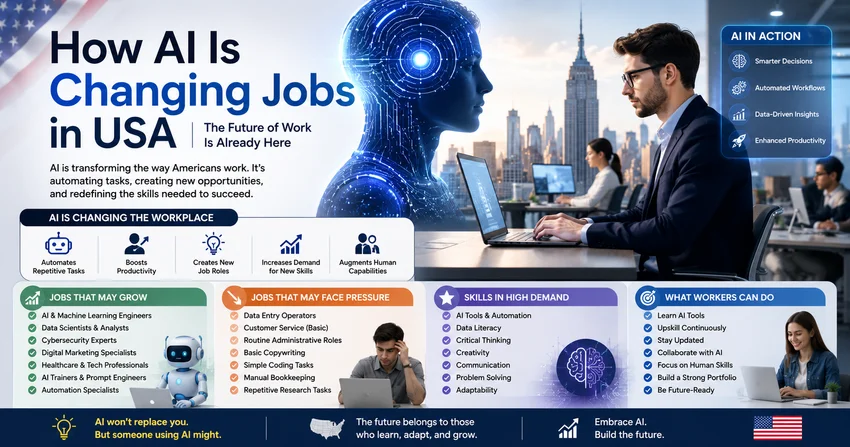
Artificial intelligence is no longer just a future technology. It is already changing how people work, how companies hire, and which skills are becoming valuable in the United States. From offices and hospitals to warehouses, schools, banks, and creative industries, AI is reshaping the American job market in a major way.
The important point is this: AI is not only replacing jobs. It is also changing jobs, creating new roles, increasing demand for certain skills, and forcing workers to adapt. Some tasks are becoming automated, while other tasks now require employees to work with AI tools to become faster, smarter, and more productive.
According to the U.S. Bureau of Labor Statistics, total U.S. employment is projected to grow by 5.2 million jobs from 2024 to 2034, with major gains expected in healthcare and professional, scientific, and technical services. This shows that the job market is still growing, but the type of work people do is changing quickly.
AI Is Changing Tasks, Not Just Job Titles
One of the biggest misunderstandings about AI is that it will simply remove entire jobs. In reality, AI is mostly changing the tasks inside jobs.
For example, a marketing professional may still create campaigns, but AI can help write drafts, analyze customer data, generate ad ideas, and prepare reports. A software developer may still build applications, but AI tools can help write code, test bugs, and speed up development. A customer service worker may still handle customers, but AI chatbots can answer basic questions before a human agent steps in.
This means many U.S. workers will not lose their jobs directly to AI, but they may need to learn new ways of working. McKinsey reported that employee use of AI at work increased sharply, from 30% in 2023 to 76% in 2025, showing how quickly AI is becoming part of everyday work.
AI Is Creating Demand for New Skills
AI is increasing demand for workers who can use, manage, and improve AI systems. These skills are not limited to engineers. Companies now want employees who understand prompt writing, data analysis, automation, AI ethics, content generation, cybersecurity, and AI-based decision-making.
Lightcast and Stanford’s 2026 AI Index found that AI skills are now mentioned in 2.5% of all U.S. job postings, up 55% from the previous year. The same report found that “agentic AI” skill mentions grew by more than 280% in one year, showing rising demand for workers who can use advanced AI systems.
This shift means job seekers in the USA can improve their career chances by learning practical AI skills, even if they are not from a computer science background.
AI Skills Can Increase Salaries
Workers with AI skills are becoming more valuable. PwC’s 2026 AI Jobs Barometer found that the average wage premium for AI skills reached 62%, meaning jobs requiring AI skills can pay significantly more than similar jobs without AI requirements.
This does not mean every worker needs to become an AI engineer. But it does mean that professionals who understand how to use AI tools in their field may have an advantage. For example, a graphic designer who can use AI for concept development, a teacher who can create AI-assisted lesson plans, or a business analyst who can use AI for reports may become more competitive.
Tech Jobs Are Still Growing, But They Are Changing
AI is changing the technology sector heavily, but it is not ending tech jobs. In fact, many technology-related occupations are projected to grow faster than average in the United States.
The Bureau of Labor Statistics projects that overall employment in computer and information technology occupations will grow much faster than the average for all occupations from 2024 to 2034, with about 317,700 openings each year on average.
Some roles are expected to grow especially fast. For example, employment of data scientists is projected to grow 34% from 2024 to 2034, while information security analysts are projected to grow 29% in the same period.
However, the nature of tech work is changing. Basic coding, simple testing, repetitive data entry, and routine technical tasks are becoming easier to automate. At the same time, demand is increasing for workers who can design systems, solve complex problems, manage data, secure networks, and evaluate AI outputs.
Entry-Level Jobs Are Becoming More Competitive
AI is also affecting entry-level roles in the USA. Many beginner-level tasks, such as basic research, first drafts, simple coding, data cleaning, and admin support, can now be done faster with AI tools. This creates a challenge for fresh graduates and junior workers because the tasks that once helped them learn on the job may be automated.
PwC’s 2026 AI Jobs Barometer noted that early-career job postings have flatlined in highly AI-exposed sectors, while more advanced entry-level roles are growing. This means employers may expect junior workers to show stronger skills earlier in their careers.
For students and fresh graduates, this means learning AI tools is no longer optional. They need to show that they can think critically, solve problems, communicate clearly, and use AI responsibly.
Some Jobs Are More Exposed to AI Than Others
AI affects jobs differently. Jobs that involve repetitive digital tasks are more exposed to automation. These include basic data entry, routine content writing, simple customer support, transcription, basic bookkeeping, and repetitive administrative work.
On the other hand, jobs that require human judgment, physical presence, emotional intelligence, creativity, leadership, and complex decision-making are harder to replace. Examples include healthcare workers, teachers, skilled tradespeople, therapists, managers, social workers, designers, and strategic consultants.
The Bureau of Labor Statistics has also started incorporating AI-related impacts into employment projections for several occupations where exposure to automation is likely.
Workers Are Worried About AI
Many American workers are unsure about how AI will affect their future. Pew Research Center found that 52% of U.S. workers feel worried about future AI use in the workplace, while 36% feel hopeful and 33% feel overwhelmed.
This mixed reaction is understandable. AI can make work easier, but it can also create pressure. Workers may fear job loss, salary pressure, increased monitoring, or the need to constantly learn new tools. At the same time, AI can reduce boring tasks, improve productivity, and create new career paths.
AI Is Helping Businesses Become More Productive
For companies, AI is attractive because it can reduce time, improve efficiency, and increase output. Businesses use AI to write emails, create content, analyze data, automate customer support, detect fraud, improve logistics, and support decision-making.
McKinsey found that generative AI has major potential value in business functions such as sales and marketing, software engineering, customer service, and research and development.
This is why companies in the USA are investing heavily in AI tools. The businesses that use AI well may become faster and more competitive. But companies also need workers who know how to use AI correctly, check its mistakes, and apply human judgment.
AI Will Not Replace Human Skills
Even as AI improves, human skills remain extremely important. AI can generate answers, but it does not truly understand context the way humans do. It can process information, but it can also make mistakes. It can create content, but it still needs human direction, editing, and judgment.
The most valuable workers will be those who combine AI skills with human skills such as:
Critical thinking
Communication
Problem-solving
Creativity
Leadership
Emotional intelligence
Ethical decision-making
Data understanding
Adaptability
In simple words, AI will reward people who know how to think, not just people who know how to follow instructions.
Which Jobs May Benefit from AI?
Many jobs in the USA may become stronger because of AI. These include:
Data scientists
AI engineers
Cybersecurity analysts
Software developers
Digital marketers
Business analysts
Healthcare technology workers
Automation specialists
UX designers
Financial analysts
Teachers using AI tools
Content strategists
Project managers
Product managers
These roles are not safe just because they are technical. They are strong because they require judgment, analysis, creativity, and the ability to use AI as a tool.
Which Jobs May Face More Pressure?
Jobs with repetitive and predictable tasks may face more pressure. These include:
Basic data entry roles
Simple admin support jobs
Routine customer service roles
Basic copywriting jobs
Low-level coding tasks
Manual report generation
Basic bookkeeping tasks
Simple research assistant tasks
This does not mean these jobs will disappear completely. But workers in these roles may need to upgrade their skills to stay competitive.
How Workers in the USA Can Prepare for AI
The best way to prepare for AI is not to fear it, but to learn how to use it. Workers should focus on building skills that AI cannot easily replace.
Here are practical ways to prepare:
Learn how to use AI tools like ChatGPT, Gemini, Claude, Microsoft Copilot, and industry-specific AI software.
Improve writing, communication, and presentation skills.
Learn data analysis basics.
Understand prompt engineering and AI-assisted research.
Build problem-solving and decision-making skills.
Stay updated with AI trends in your industry.
Use AI to improve your work, not replace your thinking.
Develop a portfolio that shows real projects and practical skills.
The future belongs to workers who can combine human intelligence with artificial intelligence.
Conclusion
AI is changing jobs in the USA by transforming tasks, increasing productivity, creating demand for new skills, and making some roles more competitive. It is not simply destroying the job market. Instead, it is reshaping the way people work.
Some jobs will be automated, some will evolve, and some new jobs will be created. Workers with AI skills, critical thinking, creativity, communication, and adaptability will have the strongest opportunities.
The key lesson is simple: AI will not replace every worker, but workers who use AI effectively may replace those who do not adapt. For students, employees, freelancers, and business owners in the USA, now is the right time to learn AI skills and prepare for the future of work.