
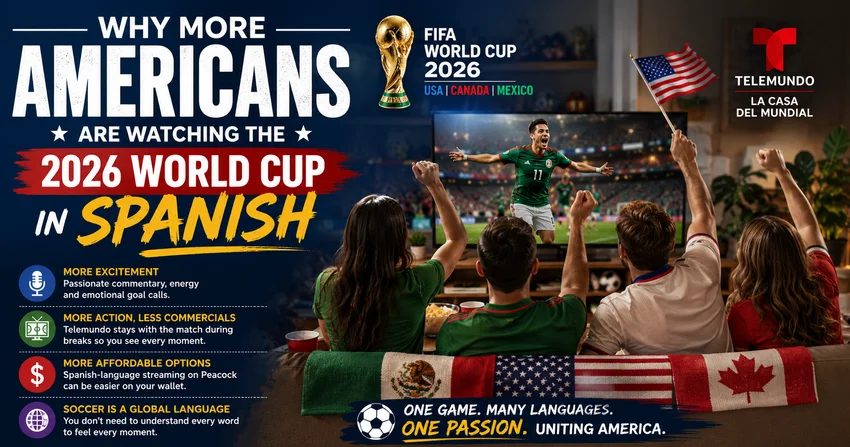
More English-speaking Americans are watching the 2026 FIFA World Cup in Spanish because they find the commentary more emotional, the broadcasts more entertaining, and the viewing options more accessible.
Some viewers also prefer Telemundo’s coverage because it continues showing the field during hydration breaks instead of moving immediately to commercials. Others choose Spanish-language streaming through Peacock because it may cost less than some English-language alternatives.
The result is a surprising cultural trend: Americans who speak little or no Spanish are choosing Spanish-language soccer coverage because the energy of the broadcast makes the game easier to feel, even when they cannot understand every word.
Soccer Does Not Always Need Translation
Soccer communicates through movement, emotion, sound, and crowd reaction.
A viewer may not understand every sentence from a Spanish-speaking commentator, but they can still recognize when a team creates a dangerous attack, misses a major opportunity, or scores a decisive goal.
The pace and tone of the commentary provide additional clues. When the announcer speaks calmly, the match may have entered a slower phase. When the speed and volume suddenly increase, viewers know that something important is happening.
This emotional clarity allows the sport to cross language barriers. Fans do not need to translate every word to understand the excitement.
Spanish Commentary Feels More Emotional
Many viewers associate Spanish-language soccer coverage with expressive commentary, longer goal calls, rapid analysis, and visible enthusiasm.
Andrés Cantor, one of the most recognizable Spanish-language soccer commentators in the United States, has become famous for his extended goal call. His delivery turns a scoring moment into a dramatic event rather than a simple update.
For some American viewers, that emotion creates a stronger connection to the match. They may understand the tactical analysis more easily in English, but they prefer the atmosphere of the Spanish broadcast.
The Associated Press reported that several English-speaking fans chose Telemundo because they found the coverage more exciting and entertaining, even when they understood very little Spanish.
Telemundo Keeps Viewers Closer to the Action
Broadcast presentation also influences the shift.
During hydration breaks, an English-language broadcast may show commercials. Telemundo has attracted praise for continuing to show players, coaches, and activity on the field during those pauses.
Those moments can reveal:
- Coaches discussing tactical changes
- Players encouraging teammates
- Signs of fatigue or frustration
- Substitutes preparing to enter
- Reactions from the crowd
- Tension between the two teams
Viewers who remain with the live scene feel more connected to the rhythm and emotion of the match.
Comedian Trevor Noah publicly praised Telemundo’s approach during his World Cup watch parties, arguing that viewers lose part of the match experience when a network replaces those moments with advertising.
Streaming Price Also Influences the Decision
Not every viewer chooses Spanish coverage because of language or commentary. Some make the switch because of cost and convenience.
U.S. audiences can watch English-language World Cup coverage through Fox and FS1, while Telemundo and Universo carry Spanish-language coverage. Peacock also streams Spanish-language matches.
For viewers who already subscribe to Peacock—or who consider it a more affordable option—the Spanish feed may provide the easiest way to follow the tournament.
This demonstrates an important change in American sports viewing. People no longer select broadcasts only by language. They also consider:
- Subscription price
- Streaming availability
- Picture quality
- Commentary style
- Advertising interruptions
- Mobile accessibility
- Overall entertainment value
Language has become one factor among many.
The 2026 World Cup Is Reaching a Wider U.S. Audience
The 2026 FIFA World Cup is the first edition to feature 48 teams, 104 matches, and three host countries: the United States, Canada, and Mexico.
Its North American location has helped turn the tournament into a major U.S. cultural event rather than a competition followed only by established soccer fans.
Television audiences have reached record levels during the tournament. The United States’ match against Belgium became the most-watched soccer telecast in U.S. history on Fox, according to figures reported by the network.
The Spanish-language audience has also become a major part of the tournament’s success. Telemundo, citing Nielsen data, said roughly half of U.S. World Cup viewers had watched at least part of some matches in Spanish.
That does not mean every viewer speaks Spanish fluently. It shows that audiences increasingly move between languages and platforms to find the experience they enjoy most.
Hispanic Culture Plays a Major Role in American Soccer
Spanish-language soccer coverage already has a large and established audience in the United States.
More than 60 million Latinos live in the country, representing almost one-fifth of the U.S. population. Latino communities have made major contributions to American culture, media, business, and sports.
Soccer holds deep cultural importance across much of Latin America. Families and communities often watch major matches together, creating traditions that pass from one generation to another.
As the 2026 World Cup brings more attention to soccer, non-Spanish-speaking Americans are encountering those traditions more directly. Watching Telemundo can offer them more than a different commentary track. It can introduce them to a different style of experiencing the sport.
Some Fans Are Using Soccer to Learn Spanish
The trend also has an educational side.
Viewers may begin recognizing common soccer terms after watching several matches. Repeated words and phrases become easier to understand because the action on screen provides context.
A fan might learn words connected with:
- Goals
- Penalties
- Fouls
- Goalkeepers
- Referees
- Corners
- Injuries
- Substitutions
- Victories and defeats
The Associated Press highlighted an English-as-a-second-language teacher who used Spanish-language World Cup broadcasts both for entertainment and as an informal way to engage with Spanish.
Watching a soccer match will not replace structured language lessons, but it can help learners become familiar with pronunciation, rhythm, emotion, and frequently repeated vocabulary.
Is Spanish Commentary Better Than English Commentary?
Neither option is objectively better for every viewer.
English-language coverage may suit fans who want detailed analysis they can understand immediately. Spanish-language coverage may appeal more to viewers who prioritize emotion, continuous action, and a lively atmosphere.
The best broadcast depends on what the viewer values most.
Choose English-language coverage when you prefer:
- Detailed explanations in English
- Tactical analysis you can follow closely
- Familiar presenters and studio teams
Choose Spanish-language coverage when you prefer:
- Highly expressive commentary
- A more emotional match atmosphere
- Fewer interruptions during certain breaks
- Spanish-language learning opportunities
- Streaming access through Telemundo, Universo, or Peacock
Some fans switch between both feeds throughout the tournament.
What This Trend Says About Modern America
The rise of English-speaking viewers choosing Spanish World Cup broadcasts reflects a broader change in American culture.
Audiences increasingly interact with entertainment across languages. Music, television, sports, and social media no longer remain inside traditional language categories.
People may watch a Korean series with subtitles, listen to Spanish music without understanding every lyric, or follow a soccer match through commentary in another language.
The emotional experience often matters more than complete linguistic understanding.
The World Cup makes this especially visible because soccer already functions as a global language. A goal, a missed penalty, or a last-minute victory produces an immediate reaction regardless of the commentary language.
Could This Change Future Sports Broadcasting?
The popularity of Spanish-language coverage among bilingual and English-speaking audiences may influence how media companies approach future sports rights.
Broadcasters may place greater value on flexible packages that combine English and Spanish coverage across television and streaming platforms.
They may also study why audiences move between broadcasts. Commentary style, subscription costs, commercial breaks, and platform availability could become just as important as language.
The Associated Press reported that the tournament’s broadcasting success could affect competition for future World Cup media rights, including rights connected with the 2030 tournament.
Frequently Asked Questions
Why are English-speaking Americans watching the World Cup in Spanish?
Many prefer the excitement of Spanish commentary, the extended goal calls, fewer interruptions during hydration breaks, and affordable streaming access through Peacock. Some viewers also use the broadcasts to practice Spanish.
Where can Americans watch the 2026 World Cup in Spanish?
U.S. viewers can watch Spanish-language World Cup coverage through Telemundo and Universo. Peacock also provides Spanish-language streaming coverage.
Do viewers need to understand Spanish to enjoy the broadcast?
No. The action, crowd noise, tone, and intensity of the commentary help viewers follow the match even when they do not understand every word.
Who is the Spanish commentator known for the long goal call?
Andrés Cantor is widely known for his extended and emotional goal call during Spanish-language soccer broadcasts.
Why do some viewers prefer Telemundo during hydration breaks?
Telemundo may continue showing activity on the field during hydration breaks, allowing viewers to observe players and coaches instead of immediately moving away from the match for commercials.
Is watching soccer in Spanish a good way to learn the language?
It can support language learning by exposing viewers to pronunciation and repeated vocabulary in a clear visual context. However, viewers should combine it with structured learning for stronger results.
Will Spanish-language sports broadcasts continue growing in the United States?
The World Cup’s strong bilingual audience suggests that Spanish-language sports coverage will remain influential. Broadcasters may increasingly design coverage for multilingual audiences rather than treating English and Spanish viewers as completely separate groups.
Final Thoughts
English-speaking Americans are not switching to Spanish World Cup broadcasts because they suddenly understand every word. They are switching because the coverage delivers emotion, energy, accessibility, and a stronger feeling of connection to the match.
The trend shows how sports can bring languages and cultures together. It also proves that audiences will cross traditional media boundaries when another broadcast offers a more enjoyable experience.
For many viewers, the most important word requires no translation.
When the ball enters the net and the commentator begins the goal call, everyone understands what happened.