
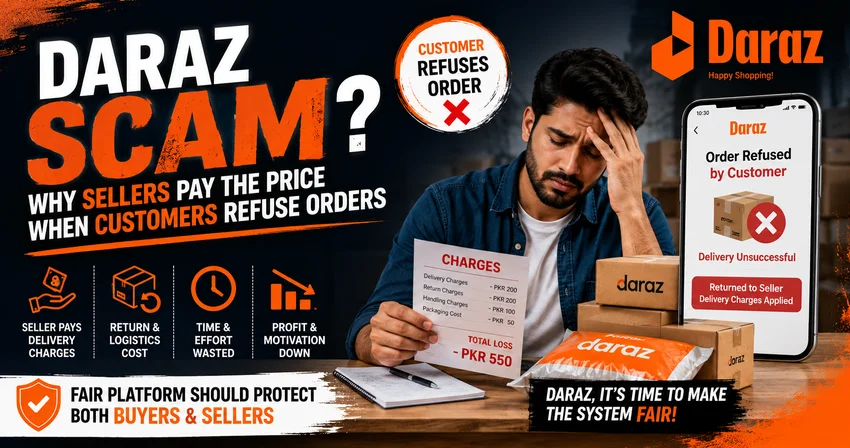
Online selling looks easy from the outside. A customer places an order, the seller packs the product, the courier delivers it, and everyone earns. But for many Daraz sellers, the reality can be very different — especially when a customer refuses to receive an order.
One of the biggest complaints from sellers is simple: when a customer rejects an order at the doorstep, the financial burden often falls on the seller. The seller has already packed the product, used time and resources, arranged dispatch, and waited for the sale. But if the customer refuses to accept the parcel, the seller may still face delivery-related charges, return logistics, delayed inventory, and sometimes damaged packaging.
This raises an important question: if the platform is Daraz, the order system is Daraz, and the courier network is also controlled or managed through Daraz’s logistics system, why should only the seller suffer the penalty when the customer refuses delivery?
The Problem: Sellers Pay for a Customer’s Refusal
Cash on delivery is still one of the most common payment methods in Pakistan. Many buyers place orders without making any advance payment, which increases the risk for sellers. In some cases, customers genuinely change their mind before delivery. Others are unavailable, do not answer calls, refuse the parcel after seeing the delivery charges, or place orders without serious buying intent.
For the customer, refusing an order may feel like a small action. But for the seller, it can mean a direct loss.
The seller may lose:
- Packaging cost
- Courier or delivery charges
- Return delivery charges
- Time spent processing the order
- Product presentation quality
- Inventory availability during the delivery cycle
- Cash flow due to delayed settlement
This is especially unfair for small sellers. A big brand may absorb repeated losses, but a small seller working on thin margins cannot survive if multiple orders are refused in a week.
Why Sellers Feel the System Is Unfair
Daraz’s own terms tell customers not to reject delivery or provide false or incomplete shipping details. Daraz also advises customers to accept the product and follow the return policy if the item is defective or not what they ordered.
This is important because it shows that order refusal is not encouraged by the platform. But the real issue is enforcement. If a buyer refuses an order without a valid reason, what meaningful penalty does the buyer face? And if there is no serious buyer-side accountability, why does the seller have to pay for the failed transaction?
Daraz also states that returning a product back to Daraz does not require the customer to pay shipping charges, and its refund policy says the shipping fee is refunded along with the eligible returned product amount.
From a customer-experience perspective, this may sound convenient. But from a seller’s perspective, it creates a major imbalance: the customer gets flexibility, the platform protects the customer journey, but the seller often absorbs the cost of uncertainty.
The Courier Question: Who Controls the Delivery?
Daraz promotes Daraz Express as its premium shipping service for deliveries across Pakistan, with delivery timelines shown for customers.
This matters because sellers are not always independently choosing the full delivery process. The order comes through Daraz. The seller follows Daraz’s seller system. The shipment moves through Daraz-linked logistics. The customer experience is managed under the Daraz brand.
So when an order fails because the customer refuses delivery, sellers naturally ask: why is the seller treated as the easiest party to charge?
If the platform controls the marketplace and logistics experience, then the platform should also create a fair protection system for sellers.
Why This Feels Like a “Seller-Side Scam”
Many sellers use the word “scam” not because every transaction is fake, but because the system feels one-sided. The seller is expected to maintain performance, dispatch on time, follow packaging rules, respond to complaints, manage stock, and absorb losses. But when the buyer refuses the parcel, the seller often has limited protection.
A fair marketplace should protect both sides. Buyers deserve protection from fake products, late deliveries, damaged items, and misleading listings. But sellers also deserve protection from unserious orders, fake COD attempts, repeated refusals, and unfair delivery penalties.
The current experience makes many sellers feel that the platform benefits from order movement while the seller carries the risk.
The Impact on Small Businesses
Small online sellers are not just “vendors.” Many are home-based entrepreneurs, students, women-led businesses, small wholesalers, or local brands trying to build a digital presence. For them, every rejected order matters.
Imagine a seller selling a product with a profit margin of Rs. 150 to Rs. 300. If that order is refused and the seller is charged delivery-related costs, the profit from one or two successful orders may be wiped out. If the product packaging is damaged during return, the loss becomes even bigger.
This discourages small businesses from selling online. Instead of empowering sellers, the system starts feeling risky and unpredictable.
What Daraz Should Improve
Daraz can solve this issue without harming genuine customers. The goal should not be to punish every buyer. The goal should be to identify irresponsible buying behavior and protect honest sellers.
Here are some improvements that would make the system fairer:
1. Penalize repeated order refusals
If a customer refuses multiple COD orders without valid reason, Daraz should restrict COD access or require advance payment for future orders.
2. Share delivery charges fairly
If the seller dispatched the order correctly and on time, the seller should not carry the full delivery penalty for customer refusal.
3. Introduce seller protection claims
Sellers should have a simple and transparent way to claim reversal of delivery charges for rejected orders where the seller was not at fault.
4. Improve customer verification
Before dispatching COD orders, Daraz should improve buyer confirmation through OTP, call confirmation, or partial advance payment for high-risk orders.
5. Show buyer refusal history
Sellers should be able to see whether a buyer has a high rejection rate before dispatching the order.
6. Protect product condition on return
If a returned rejected parcel comes back damaged due to logistics handling, the seller should be compensated.
A Marketplace Cannot Grow by Ignoring Sellers
Daraz became popular because it connected customers and sellers at a large scale. But a marketplace is only strong when both buyers and sellers trust the system.
If customers are protected but sellers feel exploited, the platform will lose quality sellers. If good sellers leave, customers will also suffer because product quality, variety, and service standards will decline.
Seller protection is not against customer protection. Both can exist together.
A fair e-commerce system should clearly define responsibility:
- When the seller sends the wrong or damaged product, the seller should be held responsible.
- Courier mishandling should be covered by the courier or platform, not pushed onto the seller.
- Customer refusal without a valid reason should come with buyer-side accountability.
- Since the platform controls the order and delivery process, it should not shift every cost to the seller.
Final Thoughts
The issue of rejected orders on Daraz is not a small complaint. It is a serious seller-side problem that affects profit, trust, and long-term business growth.
Daraz has the power to fix this by creating a more balanced system. Sellers are not asking for unfair advantage. They are asking for basic fairness.
If the customer refuses the order, and the seller has fulfilled every requirement correctly, then the seller should not be the only one punished.
A marketplace should not only be customer-friendly. It should also be seller-friendly. Because without sellers, there is no marketplace.