
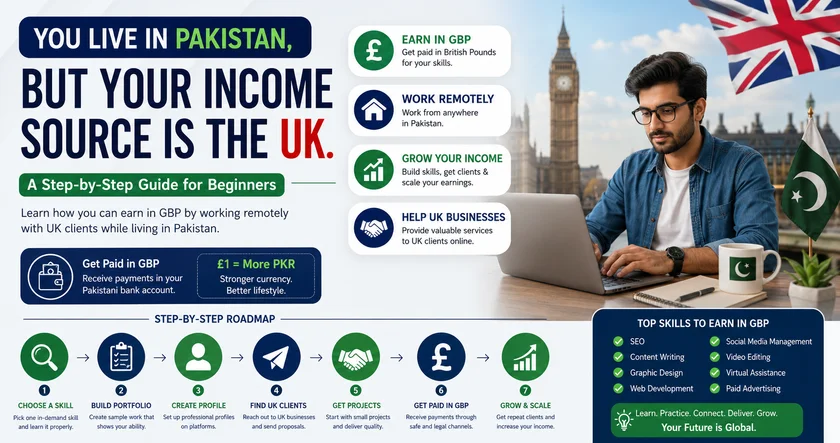
Imagine living in Pakistan, paying your daily expenses in Pakistani Rupees, but earning your income in British Pounds. For many beginners, this sounds difficult or even impossible. In reality, it is possible through remote work, freelancing, online services, digital skills, and international clients.
The simple idea is this:
You live in Pakistan, but your income source is the UK.
This means you are not physically working in the UK. Instead, you provide services online to UK-based clients, businesses, agencies, startups, schools, brands, or professionals. They pay you in GBP, and you receive the money in Pakistan through a bank account or an international payment platform.
This guide explains step by step how a new person can start earning in GBP while living in Pakistan.
What Does “Earning in GBP While Living in Pakistan” Mean?
Earning in GBP means your client, company, or customer pays you in British Pounds. Living in Pakistan means you are based in Pakistan and working remotely from your home, office, university, or co-working space.
For example:
A UK business needs social media posts.
You are a designer in Pakistan.
You create the designs online.
The UK client pays you £100.
You receive the money in Pakistan.
This is called remote work or freelancing. You are selling your skill internationally instead of only working for local clients.
Why UK Clients Hire People From Pakistan
UK businesses often hire remote workers because they need skilled people for specific tasks. Many small businesses, startups, agencies, and entrepreneurs prefer hiring freelancers because it is flexible and cost-effective.
Pakistani freelancers can provide many services such as:
- Graphic design
- Website development
- SEO
- Social media marketing
- Content writing
- Video editing
- Virtual assistance
- Data entry
- Customer support
- Accounting support
- Digital advertising
- App development
- UI/UX design
- Online tutoring
- Business research
The most important thing is not your location. The most important thing is whether you can solve the client’s problem professionally.
Step 1: Choose One Skill First
A beginner should not try to learn everything at once. The first step is to choose one clear skill.
Good beginner-friendly skills include:
- Canva design
- Social media management
- WordPress website editing
- Blog writing
- Basic SEO
- Video editing
- Data entry
- Virtual assistance
- Email management
- Customer support
- Presentation design
- Lead generation
If you already have experience in marketing, education, IT, administration, design, or communication, choose a skill connected to your background.
For example:
If you are good at writing, start with blog writing or website content.
If you are creative, start with graphic design or social media posts.
If you are technical, start with WordPress, SEO, or web development.
If you are organized, start with virtual assistance or admin support.
The goal is to become useful in one area before expanding into more services.
Step 2: Learn the Skill Properly
After choosing a skill, spend time learning it properly. You do not need an expensive degree to start, but you do need practical ability.
You can learn from:
- YouTube tutorials
- Free online courses
- Short paid courses
- Practice projects
- Internship-style work
- Online communities
- Blogs and guides
- Tool documentation
For example, if you want to offer SEO services, learn:
- Keyword research
- On-page SEO
- Meta titles and descriptions
- Blog structure
- Internal linking
- Image alt text
- Google Search Console basics
- WordPress SEO plugins such as Yoast SEO
If you want to offer design services, learn:
- Canva
- Adobe Photoshop
- Adobe Illustrator
- Typography
- Color combinations
- Social media post sizes
- Brand consistency
- Basic layout rules
Do not wait until you are perfect. Learn the basics, practice daily, and improve with real projects.
Step 3: Create Sample Work
A UK client will not hire you only because you say you can do the work. They need proof.
That proof is your portfolio.
If you are a beginner and do not have clients yet, create sample projects.
Examples:
For graphic design:
Create 10 Instagram posts for a fake restaurant, school, clothing brand, or real estate business.
For content writing:
Write 3 sample blog posts on business, education, technology, or lifestyle topics.
For SEO:
Optimize a sample WordPress page and show before-and-after improvements.
For video editing:
Edit 3 short reels using sample footage.
For virtual assistance:
Create a sample admin workflow showing calendar management, email organization, and task tracking.
Your portfolio does not need to be huge. It should show that you understand the work and can deliver clean results.
Step 4: Create a Professional Online Profile
To get UK clients, you need to look professional online. Start by creating a simple but strong profile.
You can create profiles on:
- Upwork
- Fiverr
- PeoplePerHour
- Freelancer platforms
- Facebook business groups
- Your own portfolio website
- Behance or Dribbble for design work
- GitHub for coding work
Your profile should clearly answer three questions:
- What do you do?
- Who do you help?
- What result can you provide?
Example profile bio:
“I help UK-based small businesses create professional social media content, website blogs, and SEO-friendly copy that improves their online presence.”
Another example:
“I am a Pakistan-based WordPress and SEO freelancer helping UK businesses improve website pages, blog content, and search visibility.”
Avoid writing only “I need work” or “I can do everything.” Clients prefer specialists.
Step 5: Decide What Service You Will Sell
Beginners often make the mistake of offering too many services. Keep your offer simple.
Instead of saying:
“I do design, SEO, websites, marketing, content, ads, editing, and data entry.”
Say:
“I create 12 social media posts per month for UK small businesses.”
Or:
“I write SEO blog posts for education and business websites.”
Or:
“I manage WordPress website updates for UK service-based businesses.”
A clear service is easier to sell.
Examples of beginner service packages:
Social Media Starter Package
8 posts per month
Basic captions
Hashtag suggestions
Monthly content calendar
SEO Blog Package
1,000-word blog post
SEO title
Meta description
Headings
Internal linking suggestions
WordPress Support Package
Page updates
Image replacement
Basic SEO setup
Plugin checks
Contact form testing
When your offer is clear, clients understand what they are paying for.
Step 6: Find UK Clients
There are several ways to find UK clients.
You can search for:
- UK small businesses
- UK marketing agencies
- UK schools and colleges
- UK real estate businesses
- UK law firms
- UK clinics
- UK e-commerce brands
- UK coaches and consultants
- UK startups
You can find them through:
- LinkedIn search
- Google search
- Facebook groups
- Freelancing platforms
- Business directories
- Agency websites
- Job boards
- Cold email
- Referrals
A beginner should start with small businesses because they usually need help with websites, content, design, social media, and admin work.
Step 7: Send a Professional Message
Your first message should not sound desperate. It should be short, clear, and useful.
Example message:
Hello, I came across your business and noticed you are active online. I help small businesses improve their social media content and website presence. I can create a simple content plan or sample post ideas for your brand. Would you be open to reviewing a few suggestions?
Another example:
Hello, I noticed your website has useful services but some pages could be improved with stronger SEO titles, meta descriptions, and clearer content structure. I help UK businesses optimize website pages for search and readability. I would be happy to share a few quick improvement ideas.
Do not send the same spam message to everyone. Personalize it slightly for each business.
Step 8: Start With a Small Project
As a beginner, do not try to sell a big monthly package immediately. Start with a small paid project.
Examples:
- One blog post
- Five social media posts
- One landing page rewrite
- One website SEO audit
- One logo improvement
- One short video edit
- One week of admin support
- One product description batch
Small projects help build trust. Once the client likes your work, you can offer a monthly service.
Step 9: Set Your Price in GBP
When working with UK clients, quote your price in GBP.
Beginner examples:
- Blog post: £25–£80
- Social media post design: £5–£20 per post
- Monthly social media package: £100–£400
- Basic SEO audit: £50–£150
- WordPress page update: £30–£100
- Virtual assistance: £5–£15 per hour
- Short video edit: £15–£80
These are example ranges only. Your actual price depends on your skill level, niche, experience, quality, and client budget.
Do not undercharge too much. If your price is extremely low, some clients may not take you seriously.
Step 10: Use a Simple Contract or Agreement
Before starting work, agree on the basic terms.
Your agreement should include:
- Client name
- Your name
- Scope of work
- Deliverables
- Deadline
- Payment amount
- Payment method
- Revision policy
- Ownership of final work
- Cancellation terms
For small projects, even an email agreement is better than no agreement.
Example:
“I will create 10 Instagram post designs for £100. The project includes two rounds of revisions. Final files will be delivered in PNG format within five working days after receiving the content and advance payment.”
This protects both you and the client.
Step 11: Create an Invoice
An invoice is a professional payment document. UK clients often expect it.
Your invoice should include:
- Your name
- Your address or city/country
- Client name
- Invoice number
- Invoice date
- Service description
- Amount in GBP
- Payment details
- Due date
Example invoice item:
“SEO blog writing service — 1 article — £60”
Keep every invoice saved because banks or tax consultants may ask for income proof later.
Step 12: Receive Payment in Pakistan
Pakistani freelancers can receive international payments through different methods depending on the client, platform, and bank support.
Common options include:
- Direct bank transfer/SWIFT
- Freelancing platform withdrawal
- Payoneer
- Wise where supported
- Other approved international payment channels
PSEB’s freelancer guidance mentions payment routes such as Payoneer, Wise, direct SWIFT bank transfers, Western Union/MoneyGram in limited use, and Skrill in some cases, while advising freelancers to make sure their bank supports the chosen method.
For regular freelance income, it is better to keep proper documentation such as:
- Client contract
- Invoice
- Email proof
- Platform screenshot
- Payment receipt
- Bank credit advice
- Source of funds explanation
Banks may ask questions because they need to confirm that foreign payments are legitimate. PSEB’s guidance notes that banks may ask freelancers for proof of service, invoices, platform screenshots, NTN, and source of funds declaration.
Step 13: Open the Right Bank Account
For beginners, a personal bank account may work for small payments, but if you plan to receive regular international income, ask your bank about freelancer accounts or export-related accounts.
The State Bank of Pakistan has a framework under which freelancers can open an Exporters’ Special Foreign Currency Account, also known as ESFCA, alongside a primary PKR account, either in person or through digital means.
SBP also increased the ESFCA retention limit for software, IT, IT-enabled services, and freelance services from 35% to 50% of export proceeds, allowing more flexibility for eligible exporters and freelancers.
This means that if you are serious about freelancing or IT exports, it is worth discussing freelancer banking options with your bank.
Step 14: Get NTN and Keep Tax Records
If you are earning regularly, you should keep your tax record clean. In Pakistan, freelancers often need an NTN, especially for PSEB registration, banking documentation, and tax filing.
For PSEB freelancer membership, the required documents include personal NTN, personal bank account opening or maintenance certificate, and CNIC.
PSEB also mentions that registered freelancers pay 0.25% tax on export proceeds of IT and IT-enabled services, compared with 1% for non-registered freelancers.
Tax rules can change, so always verify your current situation with FBR, PSEB, your bank, or a qualified tax consultant.
Step 15: Register With PSEB If Relevant
If you are working in IT, software, SEO, digital marketing, web development, app development, or IT-enabled services, PSEB registration may be useful.
PSEB registration can help freelancers build credibility and access relevant incentives. PSEB lists freelancer registration requirements, membership fees, and renewal requirements on its industry facilitation page.
For new freelancers, PSEB lists the membership fee as Rs. 1,000 and the renewal fee as Rs. 2,000.
This is especially helpful if you want to build a serious long-term freelance career instead of treating online work as a temporary side hustle.
Step 16: Deliver Work Professionally
Getting a client is only the beginning. Your real growth depends on delivery.
To impress UK clients:
- Reply on time
- Understand the brief carefully
- Meet deadlines
- Send clean files
- Communicate clearly
- Avoid excuses
- Ask smart questions
- Keep the client updated
- Offer solutions, not confusion
- Submit work in a professional format
A client may hire you once because of your proposal, but they will hire you again because of your professionalism.
Step 17: Ask for Feedback and Testimonials
After completing a project, ask the client for feedback.
Example:
“Thank you for working with me. If you are satisfied with the project, could you please share a short testimonial that I can add to my portfolio?”
Testimonials help new clients trust you. Even one good review can improve your chances of getting more work.
Step 18: Turn One-Time Clients Into Monthly Clients
The best way to earn stable GBP income is not by finding a new client every day. The best way is to convert satisfied clients into monthly clients.
For example:
If you wrote one blog post, offer a monthly blog package.
If you designed five posts, offer monthly social media management.
If you fixed one website page, offer website maintenance.
If you edited one video, offer weekly reel editing.
Example message:
“I’m glad you liked the work. If you want, I can also support you monthly with 4 blogs, SEO optimization, and content updates so your website stays active and consistent.”
Monthly clients create predictable income.
Step 19: Improve Your English Communication
You do not need perfect British English, but you do need clear communication.
Focus on:
- Simple sentences
- Professional tone
- Correct grammar
- Clear deadlines
- Clear pricing
- Clear project updates
Avoid slang, unclear messages, or overpromising.
Instead of saying:
“Sir I will do best work give me chance.”
Say:
“Thank you for sharing the details. I can complete this within three working days. The project will include two revisions and final delivery in PDF and editable format.”
Good communication can make you stand out even more than technical skill.
Step 20: Keep Learning and Upgrade Your Skill
Once you start earning, keep improving.
If you begin with Canva design, later learn branding, Photoshop, and Illustrator.
If you begin with blog writing, later learn SEO strategy and content planning.
If you begin with WordPress updates, later learn Elementor, speed optimization, and technical SEO.
If you begin with virtual assistance, later learn CRM tools, email marketing, and automation.
Your income grows when your skill becomes more valuable.
Example Beginner Roadmap: First 90 Days
Days 1–15: Learn One Skill
Choose one skill and learn the basics. Watch tutorials, practice daily, and understand what clients actually need.
Days 16–30: Build Portfolio
Create 5 to 10 sample projects. Make them clean and professional. Upload them to Google Drive, Behance, LinkedIn, or a simple website.
Days 31–45: Create Profiles
Create your LinkedIn, freelancing profiles, and portfolio. Write a clear bio and add your sample work.
Days 46–60: Start Outreach
Message UK small businesses, agencies, and professionals. Send 10 to 20 personalized messages daily. Apply for beginner-friendly projects.
Days 61–75: Get First Small Project
Offer a small paid task. Focus on quality, communication, and fast delivery.
Days 76–90: Build Repeat Work
Ask for testimonials. Offer monthly services. Improve your pricing. Keep sending proposals and building relationships.
Best Skills to Earn in GBP From Pakistan
Some skills have strong international demand.
1. SEO
UK businesses need website traffic. SEO services can include keyword research, blog optimization, meta titles, meta descriptions, and website audits.
2. Content Writing
Businesses need blogs, landing pages, product descriptions, email copy, and website content.
3. Graphic Design
Social media posts, brochures, logos, banners, and brand kits are always in demand.
4. Web Development
WordPress, Shopify, and custom websites can attract better-paying clients.
5. Social Media Management
Many small businesses need help with content planning, captions, posting, and engagement.
6. Video Editing
Short-form videos, reels, YouTube shorts, and promotional videos are in high demand.
7. Virtual Assistance
Busy business owners need help with emails, scheduling, research, data entry, and admin tasks.
8. Paid Ads
Google Ads, Meta Ads, and TikTok Ads can become high-paying skills once you gain experience.
Common Mistakes Beginners Should Avoid
1. Offering Too Many Services
Start with one clear service. Specialists look more professional.
2. Working Without Payment Terms
Always agree on payment before starting.
3. Not Keeping Records
Save invoices, contracts, payment proofs, and communication.
4. Underpricing Too Much
Low prices may attract low-quality clients. Charge fairly.
5. Copy-Paste Proposals
Personalized proposals perform better than generic messages.
6. Ignoring Time Zones
UK time is different from Pakistan time. Discuss availability clearly.
7. Poor Communication
Late replies and unclear messages can lose clients.
8. Not Learning Continuously
Online work changes quickly. Keep upgrading your skills.
Is It Legal to Earn From UK Clients While Living in Pakistan?
Yes, remote freelancing and service exports are common, but you must receive money through proper channels and maintain documentation.
Pakistan has banking and export-related frameworks for freelancers. SBP has issued a freelancer account framework, and PSEB provides freelancer registration guidance.
You should also understand your tax position. For example, FBR explains that foreign-source salary of a resident individual may be exempt if foreign income tax has been paid on that salary.
However, freelance income, business income, salary, and foreign-source income can be treated differently. Always consult a qualified tax professional for your exact case.
How Much Can a Beginner Earn?
There is no fixed amount. A beginner may start with small projects and gradually increase income.
Example earning path:
First month: £50–£100
After 3 months: £150–£300
After 6 months: £300–£800
After 12 months: £1,000+ if skills, clients, and consistency improve
These are only examples. Some people earn less, and some earn more. Your income depends on your skill, communication, portfolio, client quality, and consistency.
Simple Example: How It Works
Let’s say you learn SEO blog writing.
Step 1: You create 3 sample blogs.
Step 2: You create a LinkedIn profile.
Step 3: You contact UK small businesses.
Step 4: One client asks for a blog post.
Step 5: You quote £50.
Step 6: You send an invoice.
Step 7: You write and deliver the blog.
Step 8: The client pays in GBP.
Step 9: You receive the amount in Pakistan.
Step 10: You save the invoice and payment proof.
Step 11: You ask the client for monthly work.
This is how a beginner slowly builds international income.
Final Thoughts
Earning in GBP while living in Pakistan is possible, but it requires skill, patience, professionalism, and consistency. You do not need to move to the UK to work with UK clients. You need a valuable skill, a strong portfolio, clear communication, proper payment setup, and a professional approach.
Start small. Learn one skill. Create sample work. Find UK clients. Deliver quality. Keep records. Improve every month.
The formula is simple:
Learn a skill. Sell it online. Work with UK clients. Receive payment in GBP. Build long-term income from Pakistan.
Frequently Asked Questions
Can I earn in GBP while living in Pakistan?
Yes. You can earn in GBP by working remotely with UK clients through freelancing, remote contracts, digital services, consulting, online tutoring, content writing, design, SEO, web development, or virtual assistance.
Do I need to move to the UK?
No. For remote freelance work, you can stay in Pakistan and provide services online to UK clients.
What is the best skill to start with?
For beginners, good skills include content writing, Canva design, SEO, WordPress editing, virtual assistance, video editing, and social media management.
How do I receive GBP in Pakistan?
You can receive international payments through supported payment platforms, freelance platforms, or direct bank transfers. Always check with your bank and keep proper documentation.
Do I need an NTN?
If you plan to earn regularly, NTN is highly recommended. PSEB also lists personal NTN as one of the required documents for freelancer registration.
Should I register with PSEB?
If you are working in IT, software, SEO, digital marketing, or IT-enabled services, PSEB registration may be useful for credibility, banking, and tax-related benefits.
Can beginners get UK clients?
Yes, but beginners should start with small projects, build a portfolio, send personalized proposals, and focus on professional delivery.
Is freelancing guaranteed income?
No. Freelancing is not guaranteed. It takes time to build skills, find clients, and create stable income. Consistency is important.