
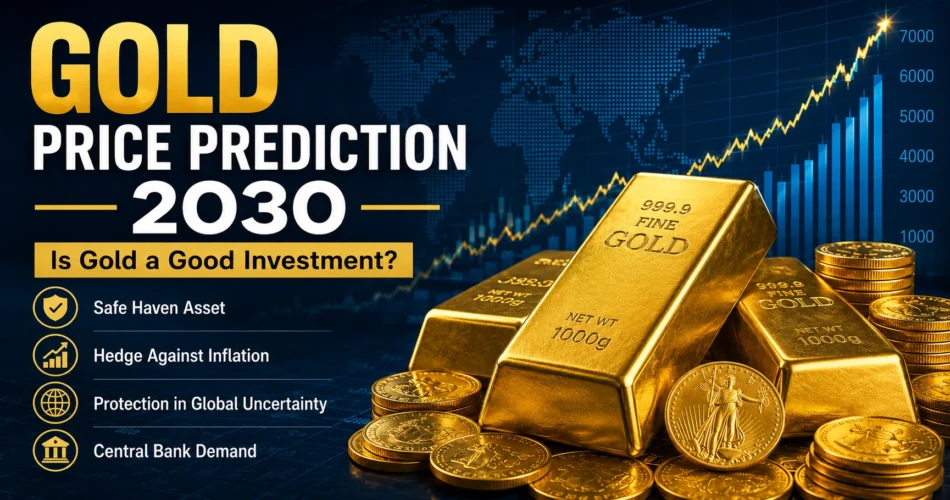
Gold has always been more than just a precious metal. For centuries, it has been a symbol of wealth, security, and financial protection. In uncertain economic times, investors often turn to gold because it is considered a safe-haven asset.
As we move closer to 2030, many investors are asking one important question: will gold prices continue to rise, and is gold still a good investment for the future?
The simple answer is: gold can be a strong long-term investment, especially for people who want protection against inflation, currency depreciation, and global uncertainty. However, like every investment, gold also comes with risks, and investors should understand both the opportunity and the caution before buying.
What Is the Current Situation of Gold?
Gold prices have already reached historically high levels in recent years. According to Reuters, spot gold was trading around $4,125 per ounce on July 8, 2026, as investors reacted to geopolitical tensions, inflation concerns, U.S. dollar movement, and Federal Reserve interest-rate expectations.
This shows that gold is not only driven by jewellery demand. Its price is strongly connected to global economics, central-bank policies, interest rates, inflation, and political uncertainty.
Gold Price Prediction 2030: What Could Happen?
No one can predict the exact gold price in 2030. Gold prices change because of many global factors, including inflation, interest rates, war, currency strength, central-bank buying, and investor sentiment.
However, based on current market trends and long-term demand, gold could remain strong by 2030.
Possible Gold Price Scenarios for 2030
| Scenario | Possible Gold Price by 2030 | Explanation |
|---|---|---|
| Conservative Scenario | $3,500–$4,500 per ounce | If inflation cools down and interest rates remain high |
| Base Scenario | $5,000–$6,500 per ounce | If inflation, safe-haven demand, and central-bank buying continue |
| Bullish Scenario | $7,000+ per ounce | If global uncertainty, currency weakness, and inflation increase |
The London Bullion Market Association has also published a long-term view discussing a rational case for $7,000 gold by 2030, based on inflation, real interest rates, and gold’s valuation premium.
This does not mean gold is guaranteed to reach $7,000. It means that under the right economic conditions, such a price level is possible.
Why Gold May Increase by 2030
1. Inflation Protection
Gold is often used as a hedge against inflation. When the value of paper currency falls, gold usually becomes more attractive because it holds long-term value better than many currencies.
If inflation remains high over the coming years, investors may continue buying gold to protect their purchasing power.
2. Central Banks Are Buying Gold
One of the biggest reasons gold has remained strong is central-bank demand. The World Gold Council reported that central banks bought 244 tonnes of gold in Q1 2026, showing continued interest from official institutions.
When central banks buy gold, it gives confidence to long-term investors because it shows that major financial institutions still trust gold as a reserve asset.
3. Global Uncertainty
Gold usually performs well when investors are worried about wars, financial crises, political instability, or recession.
The World Gold Council stated that geopolitical risk, inflation, and strong investment demand are expected to continue supporting gold demand.
If the world remains uncertain, gold may continue to attract investors looking for safety.
4. Currency Depreciation
For countries where the local currency loses value against the U.S. dollar, gold becomes even more important. Since international gold is priced in dollars, a weaker local currency can increase the local gold price.
This is especially important for investors in countries like Pakistan, India, and other emerging markets where currency depreciation can reduce savings value over time.
5. Limited Supply
Gold is a limited natural resource. Unlike paper money, it cannot be printed. Mining new gold is expensive, slow, and limited. This scarcity gives gold long-term value.
As demand grows and supply remains limited, gold may continue to benefit over the long term.
Is Gold a Good Investment for 2030?
Yes, gold can be a good investment for 2030, especially for long-term investors who want stability and protection. But gold should not be treated as a “get rich quick” investment.
Gold is best for:
- Protecting wealth
- Diversifying your portfolio
- Hedging against inflation
- Reducing risk during market uncertainty
- Preserving value during currency weakness
Gold may not always give fast returns like stocks, crypto, or high-growth businesses. But it has one major advantage: it protects wealth when other assets become risky.
How Much Gold Should You Have in Your Portfolio?
For most investors, keeping 10% to 20% of total investment portfolio in gold can be a smart strategy.
For example, if someone has a portfolio of stocks, real estate, cash, mutual funds, or business investments, gold can act as a safety layer.
A balanced investment portfolio may look like this:
| Asset Type | Suggested Allocation |
| Stocks / Mutual Funds | 30%–40% |
| Real Estate / Property | 20%–30% |
| Gold | 10%–20% |
| Cash / Emergency Fund | 10%–15% |
| Business / Other Investments | 10%–20% |
This allocation depends on age, income, risk tolerance, and financial goals. Investors who want more safety may hold more gold, while aggressive investors may hold less.
Best Ways to Invest in Gold
1. Gold Bars and Coins
Gold bars and coins are better for investment than jewellery because they usually have lower making charges. Always buy from trusted and verified sellers.
2. Gold ETFs
Gold ETFs allow investors to invest in gold without physically storing it. These are more common in developed financial markets.
3. Digital Gold
Some platforms offer digital gold investment, but investors should only use regulated and trusted platforms.
4. Gold Savings Plan
Buying gold gradually every month can reduce the risk of buying at the wrong price. This strategy is called averaging.
Gold Jewellery vs Gold Investment
Many people buy jewellery thinking it is an investment. However, jewellery is not always the best investment option because it includes making charges, design cost, wastage, and resale deductions.
For investment purposes, gold bars, coins, or certified investment-grade gold are usually better than jewellery.
Jewellery is good for personal use, weddings, and gifting. But for pure investment, physical bullion or regulated gold products are usually more efficient.
Risks of Investing in Gold
Gold is strong, but it is not risk-free.
Main risks include:
- Gold prices can fall in the short term
- High interest rates can reduce gold demand
- A strong U.S. dollar can pressure gold prices
- Physical gold has storage and security risks
- Jewellery has making charges and resale deductions
- Buying from unreliable sellers can create purity issues
This is why investors should buy gold carefully, gradually, and from trusted sources.
Should You Buy Gold Now or Wait?
The better strategy is not to invest all your money at once. Instead, investors can buy gold in small amounts over time.
This approach helps reduce risk because gold prices move up and down. If the price drops, you can buy more at a lower rate. If the price rises, your earlier investment benefits.
For long-term investors, the best strategy is:
Buy gradually. Hold patiently. Avoid panic selling.
Final Verdict: Gold Investment Outlook for 2030
Gold remains one of the most trusted long-term assets in the world. By 2030, gold could continue to perform well if inflation, geopolitical tension, central-bank buying, and currency weakness remain major global concerns.
A realistic long-term gold price range for 2030 could be around $5,000 to $6,500 per ounce, while a stronger bullish scenario could push gold toward $7,000 or more.
However, investors should not depend only on gold. A smart investor builds a diversified portfolio where gold plays the role of protection, stability, and long-term wealth preservation.
If your goal is safety, inflation protection, and future financial security, gold can be a valuable part of your investment plan for 2030 and beyond.
FAQs About Gold Price Prediction 2030
What will be the gold price in 2030?
No one can predict the exact gold price in 2030. However, based on current trends, gold could trade between $5,000 and $6,500 per ounce in a base-case scenario. In a bullish scenario, it could move above $7,000 per ounce.
Is gold a good investment for the future?
Yes, gold can be a good long-term investment because it protects against inflation, currency weakness, and financial uncertainty.
Should I invest in gold now?
Investing gradually is better than buying all at once. Gold prices can move up and down, so monthly or periodic buying can reduce risk.
Is gold better than property?
Gold and property serve different purposes. Gold is more liquid and easier to sell, while property can generate rental income and long-term capital growth. A balanced portfolio can include both.
Is gold jewellery a good investment?
Gold jewellery is not the best pure investment because it includes making charges and resale deductions. Gold bars, coins, or investment-grade gold are usually better.
Can gold reach $7,000 by 2030?
It is possible in a bullish scenario, especially if inflation, currency weakness, and geopolitical risks increase. However, it is not guaranteed.
How much gold should I keep in my portfolio?
Many investors keep around 10% to 20% of their portfolio in gold for diversification and safety.
Disclaimer
This article is for educational purposes only and should not be considered financial advice. Gold prices can rise or fall depending on market conditions. Always consult a qualified financial advisor before making investment decisions.