
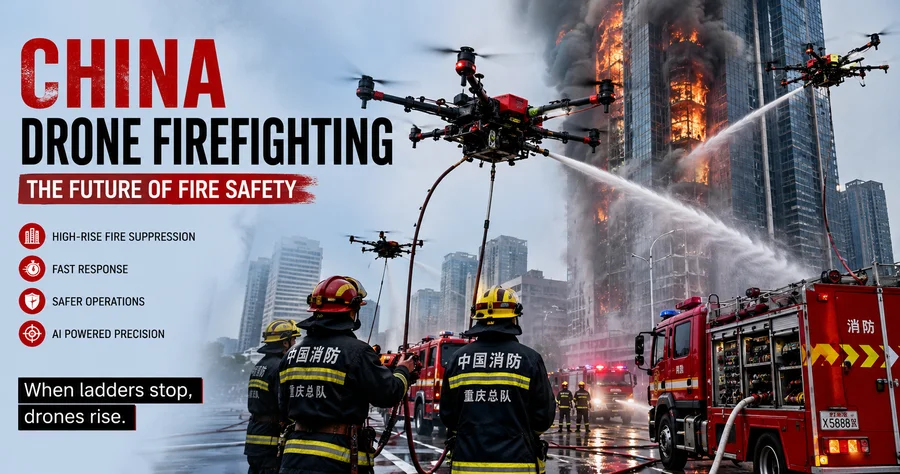
Firefighting has always been one of the most dangerous emergency services in the world. When a fire breaks out in a high-rise building, forest, industrial zone, or narrow urban area, every second matters. Traditional fire trucks, ladders, and manual rescue teams are still essential, but modern cities are becoming taller, denser, and more complex. This is where China drone firefighting technology is gaining attention.
China is testing and developing advanced firefighting drones that can fly quickly toward fire-affected areas, spray water or foam, carry fire-extinguishing materials, and assist rescue teams with aerial visibility. These drones are not replacing firefighters. Instead, they are becoming a powerful support system that helps emergency teams respond faster, reach difficult locations, and reduce risk for human responders.
What Is China Drone Firefighting?
China drone firefighting refers to the use of unmanned aerial vehicles, also known as UAVs, to support fire detection, fire suppression, rescue operations, and emergency monitoring. These drones can be used in different situations, including high-rise building fires, forest fires, industrial fires, and areas where normal fire trucks cannot easily enter.
A major use case is high-rise firefighting. In tall buildings, fire truck ladders may not always reach the upper floors. Some firefighting drones are connected to fire trucks or ground-based water sources through hose systems, allowing them to fly upward and spray water or foam directly at the affected area. CGTN reported in June 2026 that a firefighting drone in China could climb 33 stories in one minute and connect to fire trucks or other water sources through a hose.
This makes drones especially useful for modern cities where skyscrapers, traffic congestion, and limited access routes can delay traditional firefighting response.
Why China Is Investing in Firefighting Drones
China has some of the world’s largest cities, fast-growing urban infrastructure, and many high-rise buildings. As buildings become taller and urban spaces become more crowded, emergency response teams need equipment that can move quickly and reach places where humans and vehicles face limitations.
A previous high-rise drone firefighting drill in Chongqing showed how drones can help address these challenges. According to iChongqing, a UAV could reach 200 meters in about 30 seconds, while high fire engines had a height limitation of around 100 meters.
This speed and vertical reach give firefighting teams an important advantage. A drone can fly above traffic, avoid blocked streets, and reach an upper-floor fire while ground teams prepare water supply, evacuation, and rescue operations.
How Firefighting Drones Work
Firefighting drones can work in several ways depending on their design and purpose.
Some drones are connected to a hose and receive water or foam from a fire truck, hydrant, or other water source. These drones act like flying nozzles, lifting the hose upward and directing the spray toward the fire. This is useful for high-rise buildings, wall facades, and difficult urban fire points.
Other drones carry fire-extinguishing payloads. For example, the H300 firefighting drone is described as a heavy-lift UAV designed for mountainous areas, grasslands, forests, and other difficult terrains. Its product specifications list a 150 kg maximum payload, 45 minutes of maximum flight time, and four 25 kg water-based fire-extinguishing bombs that can cover about 200–300 square meters per mission.
There are also drones used mainly for monitoring. These drones can fly above a fire zone and send real-time visuals to command centers. This helps firefighters identify fire spread, smoke direction, blocked access points, and possible danger zones.
Benefits of China Drone Firefighting
The biggest advantage of firefighting drones is speed. In an emergency, a drone can launch quickly and reach areas that may take much longer for ground teams to access. This is especially important during the early stage of a fire, when fast suppression can prevent a small incident from becoming a disaster.
Another benefit is safety. Firefighters often have to enter dangerous environments with heat, smoke, falling debris, and limited visibility. Drones can inspect these areas first, giving emergency teams better information before they move in.
Drones also improve reach. In high-rise fires, a building’s height can become a serious challenge. Hose-connected drones can fly toward upper floors where ladders may not be effective. In forests, mountains, or canyons, drones can reach fire lines that vehicles cannot access easily.
They also support better decision-making. Aerial views help commanders understand the full situation, not just what is visible from the ground. With thermal imaging, cameras, sensors, and AI-assisted monitoring, drones can provide valuable data for emergency planning.
Role of AI in Firefighting Drones
Artificial intelligence is becoming an important part of modern fire response. AI-enabled drones can help detect smoke, identify heat signatures, map fire spread, and support emergency teams with faster analysis.
Research on AI-enabled unmanned aerial systems shows that drones and AI can support wildfire management before, during, and after fire events. These systems can help with detection, monitoring, evacuation planning, damage assessment, and understanding wildfire behavior.
In practical firefighting, this means drones may become more than flying cameras. They can become intelligent emergency tools that help predict where a fire is moving, detect dangerous zones, and guide firefighters with real-time data.
China Drone Firefighting for High-Rise Buildings
High-rise firefighting is one of the most important applications of this technology. Tall buildings create several challenges: limited ladder reach, strong wind at higher floors, difficult evacuation routes, and fire spreading through windows, cladding, or ventilation systems.
Firefighting drones can fly alongside the building and target the fire from outside. They can spray water or foam directly through windows or onto burning surfaces. In the Chongqing high-rise drill, the fire site was set at 50 meters high and 15 meters wide, showing how UAVs could be tested in building-fire scenarios.
This type of technology could become especially useful in large cities where high-rise residential and commercial towers are common.
China Drone Firefighting for Forests and Remote Areas
Firefighting drones are not only useful in cities. They can also support forest and grassland fire response. In remote areas, firefighters may struggle to reach fire zones quickly because of mountains, rough terrain, or limited roads.
Heavy-lift drones can carry fire-extinguishing materials to early-stage fires, while surveillance drones can monitor fire direction and help teams plan containment lines. The H300 firefighting drone, for example, is positioned for mountainous areas, forests, grasslands, and emergency response operations.
For wildfire management, drones can provide continuous aerial monitoring. They can detect smoke, track fire movement, and provide data even when ground visibility is poor.
Limitations of Firefighting Drones
Although firefighting drones are promising, they also have limitations. Payload capacity is one major challenge. Water is heavy, and drones require powerful motors, stable control systems, and reliable power to lift hoses or carry suppression materials.
Weather is another issue. Strong winds, heavy rain, extreme heat, and dense smoke can affect drone stability and visibility. Battery life can also limit flight time, especially for untethered drones carrying heavy loads.
There are also operational challenges. Fire departments need trained drone pilots, maintenance teams, safety protocols, and integration with existing emergency response systems. Drones must work safely around buildings, power lines, rescue helicopters, and crowded urban environments.
This is why the future of drone firefighting is likely to be hybrid. Firefighters, trucks, ladders, hoses, and drones will work together rather than one system replacing another.
The Future of Firefighting Technology
China’s firefighting drone development reflects a larger trend in emergency response: the move toward faster, smarter, and more flexible rescue technology. The 2024 Chengdu International Low-altitude Equipment and Services Expo showcased UAV products, firefighting and rescue equipment, and unmanned helicopters for emergency and firefighting operations, showing how low-altitude technology is becoming part of emergency innovation.
In the coming years, firefighting drones may become more advanced with stronger payload capacity, longer flight times, AI-based targeting, autonomous navigation, and better coordination with command centers. They may also become standard equipment for high-rise cities, industrial zones, airports, forests, and disaster-prone areas.
Conclusion
China drone firefighting technology shows how innovation can make emergency response faster, safer, and more effective. From high-rise buildings to forests and remote fire zones, drones can reach places that are difficult or dangerous for traditional teams.
They are not a replacement for trained firefighters, but they are a powerful support tool. By providing speed, aerial access, real-time monitoring, and targeted fire suppression, drones can help emergency teams control fires earlier and protect more lives.
As cities continue to grow vertically and climate-related fire risks increase globally, firefighting drones may become an important part of the future of public safety.
FAQs
What is China drone firefighting?
China drone firefighting is the use of UAVs to support fire detection, fire suppression, rescue monitoring, and emergency response in high-rise buildings, forests, industrial areas, and hard-to-reach locations.
Can drones put out fires?
Yes, some firefighting drones can spray water or foam through hose systems, while others can carry fire-extinguishing payloads. However, they are usually used to support firefighters rather than replace them.
Why are drones useful for high-rise fires?
Drones can fly to upper floors faster than many traditional systems and can reach areas where ladders may not be effective. They can also provide aerial views and help firefighters understand the fire situation.
Are firefighting drones safe?
Firefighting drones can improve safety by reducing the need for firefighters to enter dangerous areas immediately. However, they require trained operators, proper maintenance, and strict safety protocols.
What is the future of firefighting drones?
The future of firefighting drones includes AI detection, stronger payloads, longer flight times, real-time mapping, autonomous navigation, and better integration with fire trucks and emergency command centers.